Share:


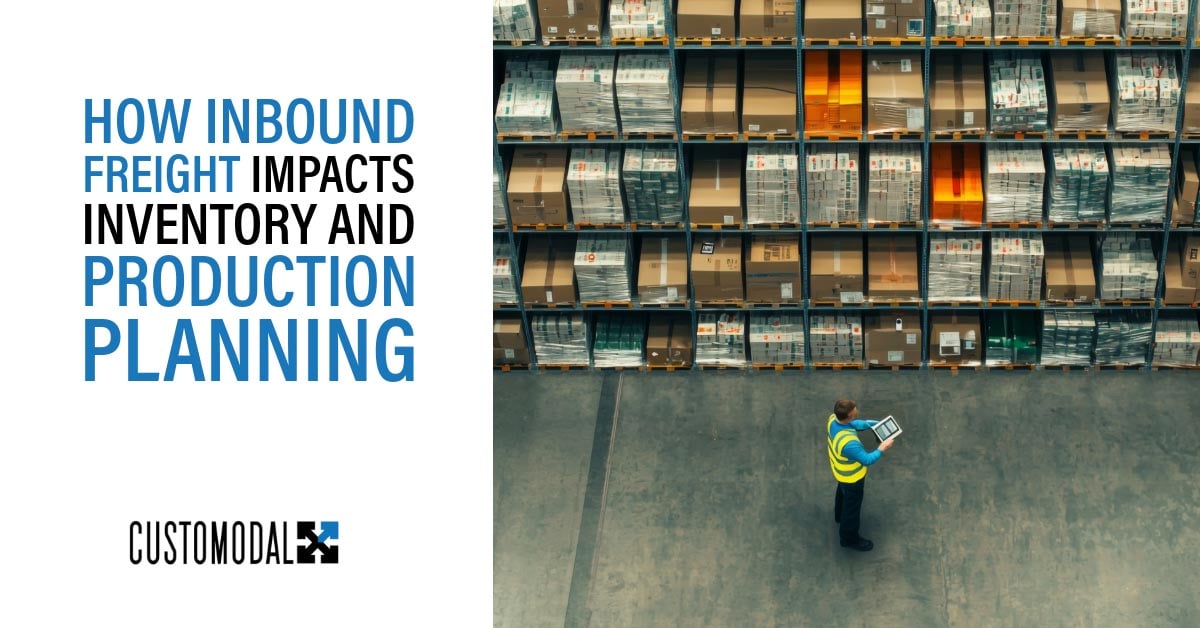
How Inbound Freight Impacts Inventory and Production Planning
Inbound freight is often treated as a transportation issue.
For manufacturers, it is also an inventory issue, a production-planning issue, and a working-capital issue.
The timing and reliability of inbound shipments influence how much inventory you carry, how much buffer you build into schedules, how often production has to adjust, and how much uncertainty the operation is forced to absorb.
That is why a freight decision cannot be judged only by what the shipment cost to move.
A transportation decision is only good if it supports the manufacturing outcome.
A shipment that arrives reliably at the right time can support leaner inventory and more predictable production.
A shipment that arrives inconsistently can force the manufacturer to protect itself with additional stock, longer lead-time assumptions, premium freight, and schedule flexibility.
Those costs may never appear on a transportation invoice, but they are part of the economics of inbound freight all the same.
Inbound Transportation and Inventory Are Closely Connected
Inventory exists partly to absorb uncertainty.
If suppliers and carriers are highly reliable, a manufacturer can often operate with more confidence around when materials will arrive.
If inbound transportation is inconsistent, the operation usually compensates.
That compensation may take the form of:
- Higher safety-stock levels
- Earlier ordering
- Larger raw-material buffers
- Longer planning lead times
- More warehouse space
- More working capital tied up in inventory
From a transportation perspective, those may look like inventory decisions.
From an operational perspective, they are often responses to transportation uncertainty.
Reliable Freight Can Reduce the Need for Buffer Inventory
Manufacturers frequently carry additional inventory because they do not trust the transportation process enough to operate closer to actual requirements.
That may be reasonable.
If a late component can stop production, carrying extra stock may be the safest decision available.
But safety stock has a cost.
Additional inventory can increase:
- Working-capital requirements
- Inventory carrying cost
- Storage requirements
- Handling activity
- Exposure to damage
- Exposure to obsolescence
The opportunity is not to eliminate safety stock simply because freight becomes more visible.
It is to understand whether part of that inventory buffer exists because the inbound transportation process is unreliable or difficult to see.
Transportation reliability can influence how much inventory the manufacturing operation feels it needs to protect production.
Early Freight Can Be Expensive Too
Late freight gets most of the attention because the consequences are obvious.
But material arriving consistently earlier than needed can also create cost.
Early arrivals may contribute to:
- Excess inventory
- Congested receiving areas
- Additional put-away activity
- More warehouse space requirements
- Higher working capital
- Additional material handling
The objective is not simply to move freight faster.
The objective is to move material in a way that supports when the manufacturing operation actually needs it.
A shipment arriving five days early may have excellent transportation performance while still creating unnecessary operational cost.
Transportation Reliability Changes Production Planning
Production planners make decisions based on assumptions.
One of those assumptions is whether the material needed for a production run will actually be available when expected.
When inbound transportation is reliable, schedules can be built with greater confidence.
When transportation is unpredictable, planners may need to build more flexibility into the schedule.
That can mean:
- Sequencing production around uncertain material availability
- Moving jobs forward or backward
- Holding capacity open
- Changing labor assignments
- Rescheduling equipment
- Adjusting customer commitments
Those changes are not free.
Even when a plant avoids a complete shutdown, frequent schedule changes can create inefficiency throughout the operation.
The Cost of a Late Shipment Is Rarely Just the Freight Cost
Imagine a shipment that was moved at a very competitive rate.
Then it arrives late.
The direct transportation cost may still look favorable.
But the manufacturing response may include:
- Production downtime
- Overtime
- Schedule changes
- Premium recovery freight
- Inventory transfers from another location
- Emergency purchasing
- Missed production targets
- Customer-service issues
Those costs can quickly overwhelm the original freight savings.
A shipment that saves $100 in transportation and creates $5,000 in production disruption is not the lower-cost shipment.
This is why freight cost control should be evaluated through total business cost rather than transportation price alone.
Visibility Gives Production More Options
Transportation visibility does not guarantee that a shipment will arrive on time.
What it can do is give the manufacturing team more time to react.
There is a significant operational difference between learning about a delay:
- Two days before the material is needed
- Two hours before the material is needed
- After the truck fails to arrive
Earlier visibility may allow the operation to:
- Resequence production
- Move inventory between facilities
- Adjust labor
- Coordinate with the supplier
- Change receiving priorities
- Make a deliberate expedited-freight decision
The transportation problem still exists.
But the cost of responding to it may be significantly lower.
The value of visibility is not simply knowing where the shipment is. It is having enough time to make a better operational decision.
Supplier Lead Time Should Include Transportation Reality
Manufacturers often think about supplier lead time as one number.
In reality, several components may be involved:
- Order processing time
- Production or preparation time
- Time waiting for pickup
- Transportation transit time
- Receiving time
If transportation performance is inconsistent, the actual lead time may be very different from the lead time used in planning systems.
That creates risk because inventory and production decisions may be based on assumptions the transportation network does not consistently support.
Reviewing inbound freight performance can help manufacturers understand whether planning lead times reflect actual transportation behavior.
Expedited Freight Is Often a Symptom, Not the Root Problem
Premium freight gets attention because the cost is easy to see.
But repeated expedited shipments often indicate a larger planning or transportation issue.
Possible causes may include:
- Supplier delays
- Poor shipment visibility
- Inaccurate lead-time assumptions
- Late ordering
- Carrier reliability problems
- Routing non-compliance
- Production schedule changes
If expedited freight is reviewed only as an expensive transportation transaction, the manufacturer may repeatedly pay to solve the symptom without addressing the process that created it.
The better question is not simply "Why did this shipment cost so much?" but "Why did this shipment need to be expedited in the first place?"
Inbound Freight Should Be Connected to Material Criticality
Not every inbound shipment carries the same operational risk.
A delay on one shipment may have almost no impact.
A delay on another may threaten production within hours.
That difference should influence transportation strategy.
Production-critical material may justify:
- Greater shipment visibility
- More reliable carrier options
- Different service requirements
- Closer supplier monitoring
- Stronger contingency planning
Lower-risk material may not require the same level of control.
This is another example of intentional control.
The objective is not to manage every shipment with the same level of intensity.
It is to align transportation control with the economic and operational consequences of failure.
Transportation, Purchasing, and Production Need the Same View
Inbound freight problems often become more expensive when responsibility is fragmented.
Purchasing may know when the supplier promised to ship.
Transportation may know which carrier is moving the freight.
Receiving may know what has arrived.
Production may know which material is becoming critical.
But if those groups are working from different information, the organization can miss problems until they become urgent.
A more mature inbound process creates shared visibility into:
- Purchase-order requirements
- Supplier commitments
- Shipment status
- Expected arrival
- Material criticality
- Transportation exceptions
The goal is not to turn every production planner into a transportation manager.
It is to make sure transportation information is available to the people whose decisions depend on it.
What Manufacturers Should Measure Together
Transportation metrics become more useful when they are connected to operational outcomes.
For example, consider reviewing:
- On-time inbound delivery
- Supplier lead-time reliability
- Expedited freight frequency
- Production disruptions tied to material availability
- Safety-stock levels for critical materials
- Inventory carrying cost
- Transportation exceptions
- Supplier and carrier performance
The purpose is not to prove that every inventory problem is a freight problem.
It is to understand where transportation reliability is influencing the way the manufacturing operation protects itself.
The Better Question Is Total Cost
Inbound freight decisions often get evaluated in transportation terms:
What did the shipment cost?
Manufacturers should also ask:
- What inventory did we need because of transportation uncertainty?
- What happens when this supplier is late?
- How often do we expedite material from this supplier?
- How much schedule flexibility do we maintain because delivery is inconsistent?
- What does a transportation failure cost production?
Freight cost control is not about minimizing the transportation line item. It is about minimizing the total cost of getting material where production needs it, when production needs it.
What Comes Next
Once manufacturers begin looking at freight through the lens of production reliability and total cost, the next question is obvious:
How do we reduce inbound freight cost without creating more operational risk?
That requires looking beyond rate negotiations and focusing on the transportation process itself.
The next article covers where manufacturers can reduce inbound freight cost while protecting the reliability production depends on.
Continue the Series
How to Reduce Inbound Freight Costs Without Disrupting Production
Cost reduction should not come at the expense of reliability. Learn where manufacturers can improve transportation cost through better control, consolidation, planning, supplier behavior, and service-level decisions without creating new production risk.
Evaluate Your Operation
How Well Is Inbound Freight Supporting Your Manufacturing Operation?
The Inbound Freight Control Assessment evaluates your current approach across transportation cost visibility, supplier control, routing, shipment visibility, performance, manufacturing integration, and internal ownership.
Your results can help identify where transportation uncertainty may be creating additional cost or operational risk.
Related Reading
Mike Eberl is the CEO of Customodal, where he helps manufacturers and shippers improve freight strategy, control transportation costs, and build stronger logistics operations. With deep experience in freight, carrier management, and supply chain strategy, Mike brings practical insight to topics like freight visibility, mode optimization, and transportation cost control.