Share:


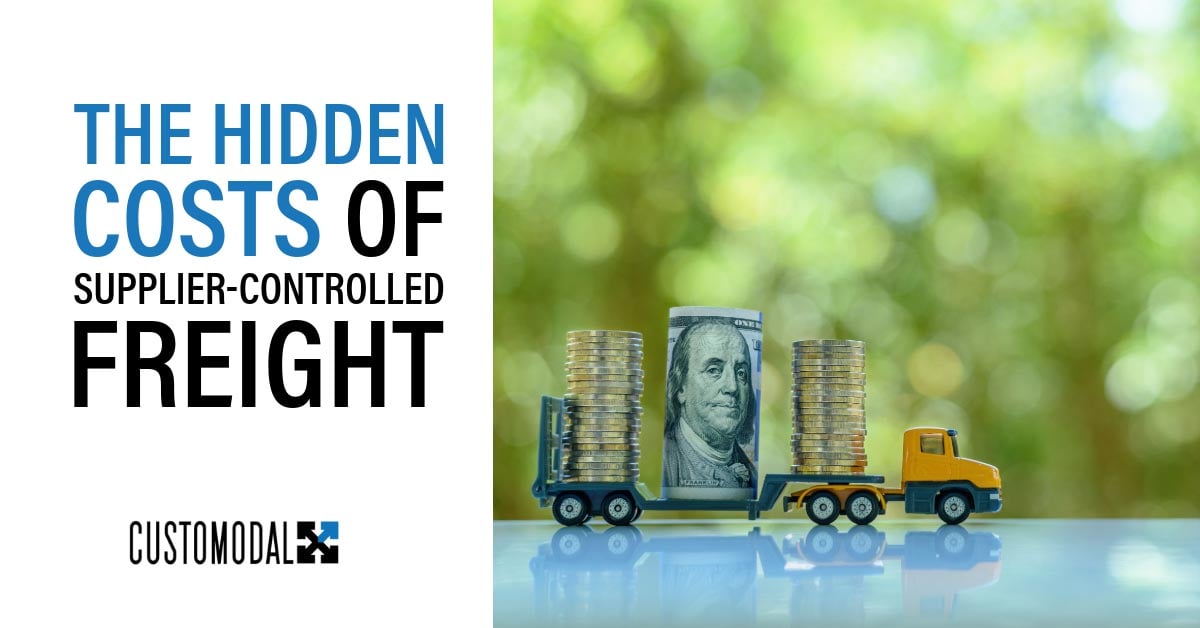
The Hidden Costs of Supplier-Controlled Freight
If you recognized your operation in several of the warning signs from our last article, the natural next question is:
What is unmanaged inbound freight actually costing us?
That question is harder than it sounds because the cost rarely appears as one number on one invoice.
Instead, it gets scattered across supplier pricing, transportation charges, inventory, production, labor, recovery freight, receiving activity, and customer service.
Most manufacturers are looking at some of those costs individually.
Far fewer are looking at them together.
As we discussed in 7 Signs Your Inbound Freight Is Unmanaged, the issue is not whether materials are arriving.
The issue is whether the transportation decisions behind those arrivals are visible, deliberate, and aligned with the needs of the manufacturing operation.
The freight invoice is only the beginning. The real cost of supplier-controlled freight often shows up somewhere else in the business.
1. The Freight Charge You See May Not Be the Real Transportation Cost
When a supplier controls transportation, the manufacturer may have limited visibility into what the shipment actually cost to move.
The freight charge may be:
- Added as a separate line item
- Included inside the delivered material price
- Passed through with administrative cost or margin
- Combined with other supplier charges
That creates several different numbers that can easily be mistaken for the same thing:
- What the carrier charged the supplier
- What the supplier charged the manufacturer
- What the transportation ultimately cost the operation
Those numbers may be very different.
If freight is buried inside material cost, accounts payable may see one ordinary supplier invoice while transportation expense remains effectively invisible.
Even when the charge is itemized, visibility alone does not tell you whether the cost was reasonable.
You still need enough information to ask:
- Was the freight marked up?
- Was the service level appropriate?
- Could the shipment have moved differently?
- Could it have been consolidated?
You cannot evaluate transportation economics accurately if the freight cost itself is hidden inside another number.
2. A Good Freight Rate Can Still Produce an Expensive Manufacturing Outcome
This is one of the most important distinctions in inbound freight management.
A shipment can have a competitive transportation rate and still be a financial failure.
Suppose one carrier option saves $100.
On the freight invoice, that looks like a win.
But if the shipment arrives late and contributes to:
- Production downtime
- Overtime
- Premium recovery freight
- A schedule change
- Additional handling
- A missed production target
- A customer-service problem
then the operation may have traded a $100 transportation savings for thousands of dollars in downstream cost.
The lowest freight price is not always the lowest total cost.
That is why freight cost control should not stop at carrier pricing.
The real question is whether the transportation decision supports the economics of the manufacturing operation as a whole.
3. Poor Reliability Gets Paid for Through Inventory
When inbound transportation is unpredictable, manufacturers often compensate with inventory.
If a supplier or carrier cannot be relied on to deliver consistently, the operation may increase:
- Safety stock
- Raw-material inventory
- Buffer stock
- Reorder lead times
Those adjustments can protect production.
But protection is not free.
Additional inventory can create:
- Higher working-capital requirements
- Inventory carrying cost
- Additional storage needs
- More handling
- Greater exposure to obsolescence or damage
In other words, inconsistent transportation performance can quietly move cost from the freight budget into the balance sheet.
And because that cost does not appear as transportation expense, it can be easy to miss the connection.
4. Limited Visibility Turns Transportation Problems Into Emergencies
Transportation delays are sometimes unavoidable.
The more important question is how early your organization knows about them.
If the supplier controls the shipment and your team has little or no visibility, the first indication of a problem may be that material fails to arrive.
At that point, what could have been a manageable scheduling issue may become an operational emergency.
The response may include:
- Expedited replacement freight
- Production resequencing
- Overtime
- Emergency supplier calls
- Inventory transfers between facilities
- Customer communication
Each of those actions carries cost.
Visibility does not eliminate the delay.
It creates time to make a less expensive decision.
The economic value of visibility is often the difference between managing an exception and reacting to a crisis.
5. Missed Consolidation Creates Cost That Never Needed to Exist
Some inbound freight costs are created not because a carrier rate is too high, but because the shipment structure itself is inefficient.
Imagine three LTL shipments leaving the same supplier during the same week.
Each shipment may have a reasonable rate.
But if two or three could have moved together, the issue is not whether the rate was competitive.
The issue is that unnecessary transportation movements were created.
Potential consolidation opportunities can include:
- Combining multiple purchase orders from one supplier
- Coordinating supplier pickup schedules
- Combining freight from suppliers in the same region
- Building multi-stop truckloads
- Reducing unnecessary shipment frequency
These opportunities are difficult to identify when suppliers make transportation decisions independently.
Each supplier sees its own shipment.
The manufacturer is the party that may be able to see the broader network.
Consolidation savings come from changing the process, not simply negotiating a lower rate.
6. Supplier-Controlled Carrier Selection Can Create a Service Mismatch
When the supplier chooses the carrier, it is reasonable for that decision to reflect the supplier's own transportation network.
The supplier may optimize around:
- Its carrier contracts
- Volume commitments
- Pickup schedules
- Administrative convenience
- Existing relationships
Those factors may be perfectly rational from the supplier's perspective.
But they may not align with what matters most to your operation.
Your priorities may be:
- Delivery-window consistency
- Production-critical transit reliability
- Shipment visibility
- Claims performance
- Receiving requirements
- Total operational cost
If the carrier repeatedly underperforms, you may also have limited leverage because the supplier, not your company, owns the carrier relationship.
The cost of that mismatch may never appear in the rate.
It appears in the operational consequences.
7. Routing Non-Compliance Creates Process Variation and Avoidable Cost
A routing guide is intended to create consistency.
But if suppliers do not follow it, the manufacturer can end up with a transportation process that looks controlled on paper and behaves very differently in practice.
Non-compliance can lead to:
- Unauthorized carriers
- Incorrect service levels
- Missed consolidation opportunities
- Scheduling problems
- Incomplete documentation
- Inaccurate shipment information and classification
- Additional transportation exceptions
The hidden cost is the gap between the process management believes is happening and the process suppliers are actually following.
That variation creates additional cost because every exception has to be absorbed somewhere by transportation, purchasing, receiving, inventory, or production.
8. Unmeasured Performance Allows Expensive Problems to Repeat
One late shipment is an exception.
Twenty late shipments from the same supplier are a pattern.
Without performance data, those two situations can look surprisingly similar.
Manufacturers need enough information to distinguish between suppliers and carriers that are consistently reliable and those that create recurring cost or disruption.
That may include measuring:
- On-time pickup
- On-time delivery
- Routing compliance
- Transportation exceptions
- Expedited freight
- Freight cost by supplier
- Carrier performance
- Claims or damage
Without measurement, recurring problems remain anecdotal.
And anecdotal problems are difficult to prioritize against everything else competing for attention inside a manufacturing operation.
If a transportation problem is not measured, its economic impact can remain hidden even when the problem itself happens repeatedly.
The Freight Invoice Is Only the Beginning
The most expensive inbound transportation problem may not appear on a freight invoice at all.
It may appear as:
- Production downtime
- Overtime
- Premium recovery freight
- Excess safety stock
- Inventory carrying cost
- Additional warehouse space
- Receiving inefficiency
- Missed production
- Customer-service failures
This is why comparing freight rates alone can produce the wrong answer.
A shipment that costs $100 less to move but creates $5,000 of operational disruption is not the lower-cost shipment.
The correct comparison is total business cost.
Why These Costs Compound
The most important point is that these costs rarely exist independently.
Limited visibility may contribute to higher safety stock.
Poor carrier reliability may trigger premium recovery freight.
Supplier-controlled routing may reduce consolidation opportunities.
Weak compliance measurement may allow the same transportation exceptions to continue month after month.
All of these problems can share the same root cause:
Nobody has enough visibility across the inbound transportation system to see how the decisions connect.
That is why inbound freight should be evaluated as a system rather than as a collection of individual freight charges.
Once manufacturers can see the system, they can begin separating supplier arrangements that are working well from those where greater control could create meaningful value.
Not Every Supplier-Controlled Arrangement Is a Problem
This distinction is important.
Supplier control is not automatically expensive.
A supplier may provide:
- Competitive transportation economics
- Strong carrier performance
- Good shipment visibility
- Reliable delivery
- Low operational risk
In that situation, there may be no compelling reason to change the arrangement.
The problem is not supplier control itself.
The problem is supplier control that has never been evaluated against cost, reliability, visibility, and operational performance.
Intentional control means changing the relationships where greater control creates value and leaving strong supplier arrangements alone where it does not.
What Comes Next
Once the hidden costs become visible, the next step is not automatically to take over every inbound shipment.
The more useful question is:
Which supplier relationships are actually worth controlling?
A high-spend supplier shipping production-critical material several times per week deserves a different transportation strategy than an occasional supplier providing low-risk material with reliable service.
The next article looks at how to make that decision supplier by supplier.
Continue the Series
Who Should Control Inbound Freight: You or Your Supplier?
The goal is not to control everything. Learn how to identify the supplier relationships where greater transportation control can improve economics, reliability, visibility, or production performance, and where supplier control may still be the right answer.
Evaluate Your Operation
How Much Control Do You Really Have Over Inbound Freight?
The Inbound Freight Control Assessment evaluates your current approach across cost visibility, supplier control, routing, compliance, shipment visibility, performance, manufacturing integration, and internal ownership.
Your results can help identify where hidden cost may be entering the operation and which areas deserve the most attention.
Related Reading
Mike Eberl is the CEO of Customodal, where he helps manufacturers and shippers improve freight strategy, control transportation costs, and build stronger logistics operations. With deep experience in freight, carrier management, and supply chain strategy, Mike brings practical insight to topics like freight visibility, mode optimization, and transportation cost control.