Share:


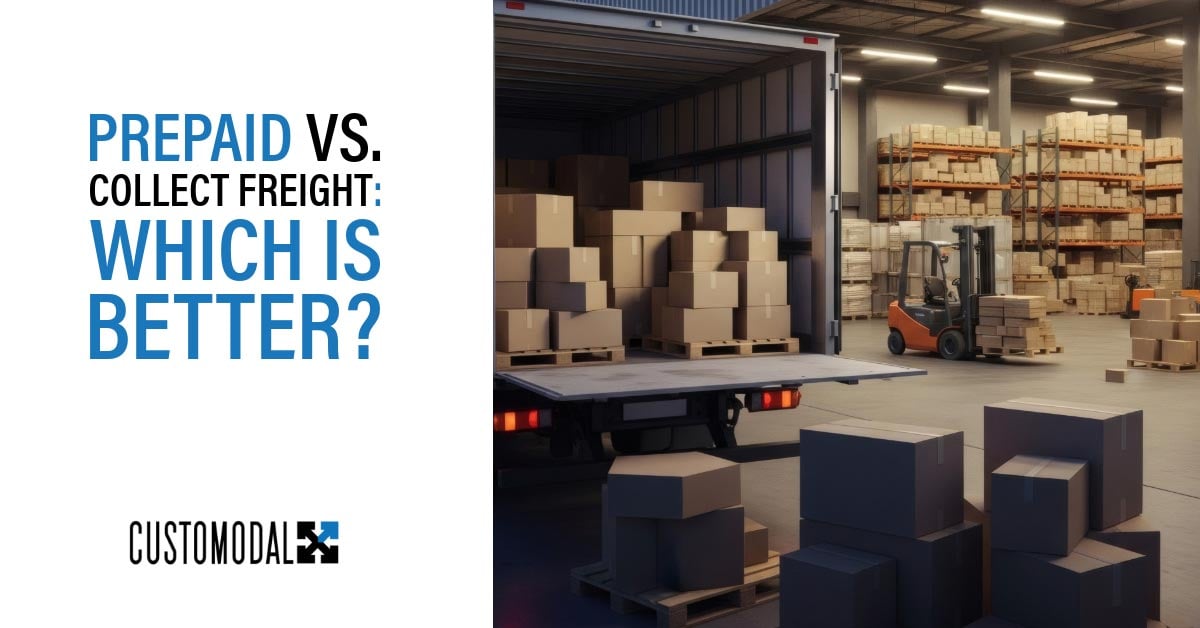
Prepaid vs. Collect Freight: Which Is Better for Manufacturers?
In our last article, we looked at the strategic question underneath inbound freight management:
Which supplier relationships should the manufacturer control, and which ones can appropriately remain supplier-controlled?
That decision should come first.
Once you know where greater control would actually create value, the next question is how to structure the freight terms so the right party has the ability to manage the shipment.
That is where prepaid and collect freight terms come in.
They may look like billing details buried inside a purchase order, but they can have a major effect on who sees the transportation cost, who manages the carrier relationship, who makes routing decisions, and who has the ability to hold transportation performance accountable.
The strategic question is where control belongs. Prepaid and collect freight are mechanisms that help put that decision into practice.
What "Prepaid" and "Collect" Actually Mean
At the simplest level, prepaid and collect describe who pays the carrier.
Freight Prepaid
With freight prepaid, the shipper, in this case your supplier, arranges the transportation and pays the carrier.
The transportation cost may then be handled in several ways.
It may be:
- Added to your invoice as a separate freight charge
- Included within the delivered price of the material
- Absorbed by the supplier as part of the commercial agreement
In a common prepaid and add arrangement, the supplier pays the carrier first and then bills the transportation cost back to you.
The important point is that the supplier typically controls the transportation transaction.
That often means the supplier selected:
- The carrier
- The transportation mode
- The service level
- The routing
You may ultimately pay for the transportation, but you may not have controlled how it was purchased.
Freight Collect
With freight collect, the transportation charges are billed to the receiver.
For a manufacturer, this usually creates a much clearer path to direct transportation control because your organization becomes the carrier's customer.
That can make it possible to:
- Select approved carriers
- Establish routing requirements
- See freight cost directly
- Measure carrier performance
- Track transportation spend
- Identify consolidation opportunities
- Hold carriers accountable for service
But there is an important distinction.
Collect freight gives you control. It does not guarantee that control will be managed well.
The Overlooked Variable: FOB Terms
Prepaid versus collect answers one question:
Who pays the freight bill?
It does not, by itself, answer another important question:
When does responsibility for the goods transfer from the supplier to the buyer?
That is determined by the FOB terms.
Manufacturers should look at the freight term and the FOB term together because the combination affects payment, risk, control, and responsibility while the material is in transit.
FOB Origin, Freight Collect
Under this arrangement, responsibility for the goods generally transfers at origin and the buyer pays the carrier directly.
For manufacturers that have deliberately decided to control a supplier's inbound transportation, this structure can provide a strong foundation.
It can allow the manufacturer to:
- Select the carrier
- Establish routing requirements
- See actual transportation cost
- Track the shipment
- Measure service performance
- Evaluate consolidation opportunities
FOB Origin, Freight Prepaid and Add
Here, responsibility for the goods generally transfers at origin, but the supplier arranges and pays for transportation before billing the freight charge back to the buyer.
This can create a mismatch between responsibility and control.
Your organization may bear the transit risk while having limited influence over:
- Carrier selection
- Routing
- Service level
- Transportation pricing
- Shipment visibility
That does not automatically make the arrangement wrong, but it does make it worth reviewing, especially for high-value, high-frequency, or production-critical material.
FOB Destination, Freight Collect
Under this arrangement, responsibility generally remains with the supplier until the shipment reaches destination, while the transportation charges are billed to the buyer.
This combination is less common and deserves close review because the manufacturer may be paying for transportation without having the level of control it expects.
FOB Destination, Freight Prepaid
In this arrangement, the supplier generally retains responsibility for the goods until delivery and also arranges and pays for transportation.
For the buyer, this can be administratively simple.
It can also provide the least direct visibility into carrier selection, freight cost, and transportation decision-making.
Why the Combination Matters
Many manufacturers focus on prepaid versus collect and overlook the FOB term attached to the shipment.
Looking at both together helps you determine whether payment, risk, and transportation control are aligned the way your organization intends.
Prepaid Freight: What You Gain
The biggest advantage of prepaid freight is simplicity.
The supplier handles the transportation transaction.
That can reduce the need for your team to manage:
- Carrier relationships
- Freight billing
- Shipment tendering
- Day-to-day transportation coordination
For low-volume, low-risk, or infrequent supplier relationships, that simplicity can be a real advantage.
Some suppliers may also have strong carrier programs and favorable transportation economics on particular lanes.
In those situations, taking control simply for the sake of taking control may add administrative work without improving the business outcome.
Intentional control does not mean controlling everything. It means leaving good supplier-controlled arrangements alone when they are economically and operationally sound.
Prepaid Freight: What You Give Up
The trade-off is visibility and direct control.
Depending on the arrangement, you may have limited insight into:
- The supplier's actual carrier cost
- Whether freight has been marked up
- Why a particular carrier was selected
- Whether the chosen service level was necessary
- Whether the shipment could have been consolidated
- How consistently the carrier performs
- Where the shipment is before it becomes late
Again, this does not make prepaid freight inherently bad.
The problem is prepaid freight that exists purely by inertia.
There is a big difference between:
"We reviewed this supplier and decided prepaid freight is the best arrangement."
And:
"That's just how they've always shipped to us."
The first is a deliberate transportation decision.
The second is a default.
Collect Freight: What You Gain
Collect freight can provide a stronger foundation when a manufacturer has already decided that a supplier relationship deserves greater transportation control.
It can create direct visibility into freight cost and a direct relationship with the carrier.
That may improve your ability to manage:
- Carrier selection
- Freight pricing
- Routing
- Transit performance
- Shipment visibility
- Supplier compliance
- Consolidation
- Transportation data
More importantly, it can help align transportation accountability with the manufacturer whose production depends on the material arriving as expected.
If the carrier repeatedly misses delivery expectations, you can measure it.
If transportation cost rises, you can see it.
If several shipments could move together, you have a better opportunity to identify that before separate freight movements are created.
Collect freight is most valuable when it gives the manufacturer better control over the total transportation outcome, not simply a different freight bill.
Collect Freight: What You Give Up
The trade-off is responsibility.
If the manufacturer controls the freight, someone has to manage the process.
That includes:
- Carrier relationships
- Routing instructions
- Transportation pricing
- Freight billing
- Shipment visibility
- Carrier performance
- Supplier compliance
- Transportation exceptions
That requires infrastructure.
For collect freight to create meaningful value, manufacturers typically need some combination of:
- A current inbound routing guide
- Approved carrier relationships
- Clear internal ownership
- Supplier communication
- Transportation visibility
- Performance measurement
- A TMS or other transportation-management support where appropriate
Without those pieces, switching to collect terms may simply move the same lack of management from the supplier's side of the transaction to the manufacturer's side.
Collect terms create the opportunity for control. Process, ownership, and measurement turn that opportunity into management.
The Freight Term Is Not the Business Outcome
This is where the prepaid-versus-collect discussion connects to the larger economics of manufacturing.
A transportation arrangement should not be evaluated only on the freight charge itself.
A shipment can have a low freight rate and still be an expensive failure if poor transportation performance contributes to:
- Production downtime
- Overtime
- Premium recovery freight
- Excess safety stock
- Inventory carrying cost
- Receiving disruption
- Missed production
- Customer-service problems
Likewise, a supplier-controlled prepaid arrangement may be perfectly effective if the supplier provides strong service, competitive economics, good visibility, and little operational risk.
The right freight term is the one that supports the best total business outcome, not necessarily the one that creates the lowest individual transportation charge.
So Which Is Better for Manufacturers?
There is no universal winner.
For a supplier relationship where the manufacturer has deliberately decided greater transportation control would create value, collect freight may provide the stronger foundation.
For a supplier that is low-volume, low-risk, transparent, reliable, and economically competitive, prepaid freight may be entirely appropriate.
The key is to make the freight term follow the strategic decision rather than allowing the freight term to make the decision for you.
That is the idea behind intentional control.
First decide where control creates value. Then choose freight terms that support that decision.
A high-volume supplier shipping production-critical material several times a week deserves a different conversation than an occasional supplier sending non-critical material a few times per year.
The freight terms should reflect that difference.
What to Ask Before Changing Freight Terms With a Supplier
Before moving a supplier from prepaid to collect, or changing any inbound freight arrangement, ask:
- Why do we want greater control of this supplier's freight?
Is the opportunity cost visibility, reliability, carrier performance, consolidation, supplier markup, production risk, or some combination of those?
- Does this supplier represent enough freight spend, shipment frequency, or production criticality to justify the change?
Control should be prioritized where it is likely to create meaningful economic or operational value.
- Do we have a carrier relationship or transportation program capable of handling the shipments?
Taking control only helps if you have a reliable process ready to replace the supplier's current arrangement.
- Do we have clear routing instructions the supplier can follow?
The supplier needs to know approved carriers, service expectations, scheduling procedures, documentation requirements, and exception processes.
- Can we measure whether the supplier and carrier are following the process?
Control without measurement can quickly become another unmanaged process.
- Who internally owns transportation cost and performance?
Someone should be accountable for freight spend, carrier performance, supplier compliance, and transportation exceptions.
- What FOB terms are paired with the freight terms?
Make sure payment, risk, and control are aligned with the arrangement your organization intends to create.
- What is the expected total-cost benefit?
Do not evaluate the change only on freight rate. Consider reliability, inventory, recovery freight, production impact, and administrative cost as well.
If you can answer those questions clearly, you are in a much better position to make a supplier-by-supplier decision.
Freight Terms Should Follow Strategy
Prepaid and collect freight terms matter.
But they are not the strategy.
The strategy is deciding where your organization needs transportation control, where supplier control is working well, and what structure produces the best total business outcome.
Prepaid can provide simplicity.
Collect can provide direct control.
And a strong inbound freight strategy may use both across different supplier relationships.
The important thing is that the terms reflect a deliberate decision rather than a historical default.
Continue the Series
Inbound Freight Audit: 10 Questions Manufacturers Should Ask
Once you understand where control belongs and how freight terms support that decision, the next step is establishing a clear baseline of what is actually happening today across cost, carrier selection, routing, visibility, supplier behavior, and performance.
Evaluate Your Operation
How Much Control Do You Really Have Over Inbound Freight?
The Inbound Freight Control Assessment evaluates your current approach across cost visibility, supplier control, routing, compliance, shipment visibility, performance, manufacturing integration, and internal ownership.
Your results can help identify where greater control would create value and where existing supplier-controlled arrangements may already be working well.
Related Reading
Mike Eberl is the CEO of Customodal, where he helps manufacturers and shippers improve freight strategy, control transportation costs, and build stronger logistics operations. With deep experience in freight, carrier management, and supply chain strategy, Mike brings practical insight to topics like freight visibility, mode optimization, and transportation cost control.