Share:


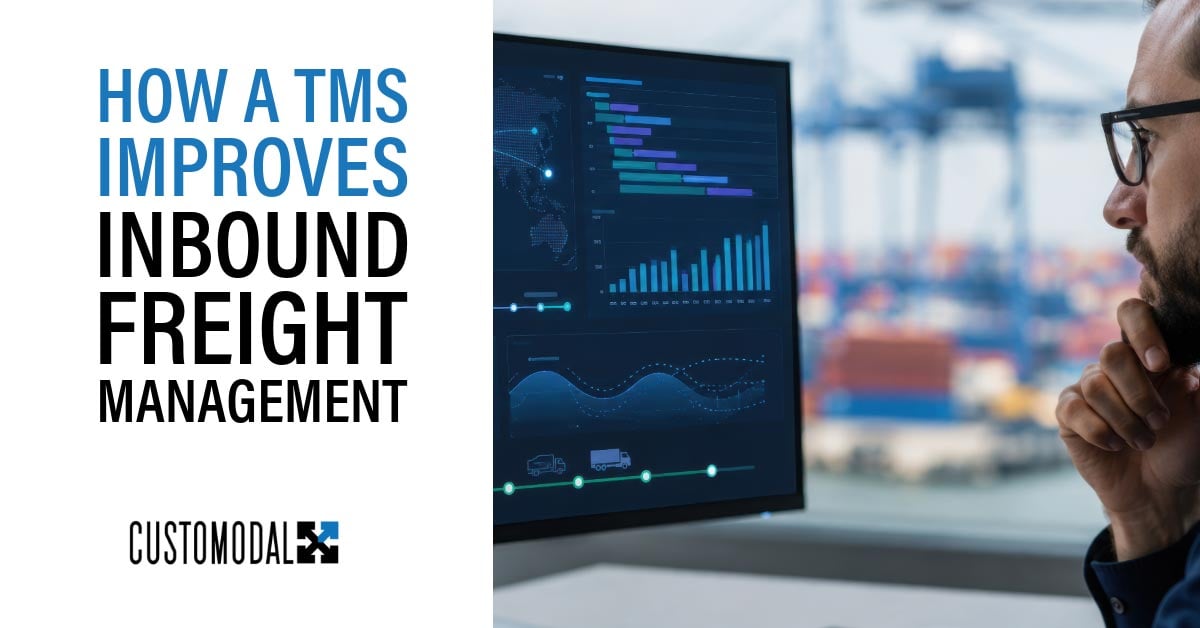
How a TMS Improves Inbound Freight Management
At a certain point, managing inbound freight through spreadsheets, email, supplier portals, and individual carrier websites becomes difficult to sustain.
That is where a Transportation Management System, or TMS, can become valuable.
A TMS can help manufacturers centralize planning, execution, visibility, carrier management, reporting, and transportation data.
But there is an important distinction:
Technology supports a transportation strategy. It does not create one.
Manufacturers still need to decide what they want to control, what suppliers should be responsible for, how transportation should support production, and who owns the process internally.
What a TMS Actually Does
A TMS is software designed to help plan, execute, monitor, and analyze transportation activity.
Depending on the platform, it may support:
- Carrier selection
- Freight rating
- Shipment tendering
- Routing
- Shipment tracking
- Exception management
- Freight audit
- Reporting
- Carrier performance
- Supplier compliance
- Transportation analytics
The value is not simply having more software.
The value comes from bringing transportation activity into one process where decisions and performance can be managed consistently.
1. A TMS Can Centralize Inbound Transportation Data
One of the most common problems in inbound freight management is fragmented information.
Shipment data may live across:
- Supplier emails
- Carrier websites
- Spreadsheets
- Purchase-order systems
- Receiving systems
- Individual employee inboxes
A TMS can bring more of that transportation information into one place.
That can make it easier to understand:
- What is currently moving
- Which carrier is handling each shipment
- What transportation costs
- Which shipments are at risk
- How suppliers and carriers are performing
Centralized data does not automatically create good decisions.
But it can make good decisions much easier to make.
2. A TMS Can Improve Carrier Selection
Carrier selection is more useful when it is based on a defined set of criteria rather than habit.
A TMS can help compare carriers based on factors such as:
- Rate
- Service level
- Transit time
- Lane suitability
- Historical performance
This supports a more deliberate carrier decision.
The important point is that the software should reflect the manufacturer’s transportation strategy.
If the only rule is “choose the lowest rate,” the system may optimize for transportation price while ignoring service and production requirements.
The TMS should help execute the strategy you want, not silently become the strategy for you.
3. A TMS Can Improve Shipment Visibility
Shipment visibility becomes more useful when it is connected to exception management.
A TMS can help manufacturers see:
- Whether freight has picked up
- Expected arrival
- Transit status
- Delays
- Transportation exceptions
That can help the organization act before a late shipment becomes a production problem.
Again, the objective is not simply tracking.
It is getting useful information to the right people early enough to change the outcome.
4. A TMS Can Help Enforce Routing Rules
Routing guides are easier to manage when transportation rules are built into a system.
A TMS can help support:
- Approved carrier usage
- Service-level rules
- Routing requirements
- Scheduling requirements
- Exception approvals
This can reduce the amount of transportation decision-making that depends on someone remembering the rule manually.
It can also make non-compliance easier to identify.
5. A TMS Can Create Better Supplier Compliance Data
Supplier compliance becomes more useful when it is measurable.
A TMS can help capture data related to:
- Carrier usage
- Shipment timing
- Routing exceptions
- Accurate shipment information and classification
- Service-level compliance
That gives manufacturers a stronger foundation for supplier scorecards and performance discussions.
It also helps separate anecdotal problems from recurring patterns.
6. A TMS Can Make Consolidation Opportunities Easier to See
Consolidation depends on visibility before the freight moves.
A TMS can help manufacturers identify:
- Multiple shipments from the same supplier
- Repeated LTL lanes
- Orders that could move together
- Suppliers located in the same region
- Potential multi-stop opportunities
This can help reduce cost by changing shipment structure rather than simply negotiating a lower rate.
7. A TMS Can Improve Freight Audit and Cost Visibility
Transportation cost becomes easier to manage when it is captured consistently.
A TMS may help manufacturers compare:
- Quoted versus billed cost
- Freight cost by supplier
- Freight cost by lane
- Freight cost by carrier
- Accessorial charges
- Expedited freight
This creates better visibility into where transportation spend is concentrated and where recurring cost issues exist.
8. A TMS Can Improve Performance Measurement
Transportation data becomes much more useful when it can be measured consistently.
A TMS can help support KPIs such as:
- On-time pickup
- On-time delivery
- Carrier performance
- Supplier compliance
- Exception frequency
- Expedited freight
- Freight cost trends
This supports better decision-making around carriers, suppliers, and transportation strategy.
9. A TMS Can Reduce Manual Transportation Work
Many inbound transportation processes rely heavily on manual activity.
Employees may spend time:
- Requesting rates
- Checking carrier websites
- Emailing suppliers
- Updating spreadsheets
- Tracking shipments
- Recreating transportation reports
A TMS can automate or simplify some of that work.
That can free internal teams to spend more time managing exceptions, supplier performance, and improvement opportunities.
10. A TMS Can Create More Consistency Across Locations
Manufacturers with multiple plants or facilities may have different inbound transportation practices at each location.
One plant may use preferred carriers.
Another may rely heavily on supplier-controlled freight.
A third may track performance manually.
A shared TMS can help create more consistent:
- Carrier rules
- Routing processes
- Shipment visibility
- Transportation data
- Performance reporting
That can help the organization manage inbound freight as a network rather than as a collection of individual locations.
What a TMS Cannot Do by Itself
This is the most important part of the discussion.
A TMS cannot decide your transportation strategy for you.
It cannot answer questions such as:
- Which suppliers should remain supplier-controlled?
- Where should the manufacturer take greater control?
- What service level does production actually require?
- Which transportation failures matter most?
- Who owns inbound freight internally?
Those are business decisions.
Technology can help execute them.
Buying a TMS does not create intentional control. It gives you tools to execute intentional control more consistently.
Technology Can Digitize a Bad Process Too
A manufacturer can implement transportation software and still have an unmanaged inbound freight program.
For example:
- Supplier control decisions may still be historical defaults
- Routing instructions may still be unclear
- No one may own transportation performance
- KPIs may still focus only on freight cost
- Operations may still be disconnected from transportation decisions
In that situation, the organization may simply automate an inconsistent process.
That is why process design should come before or alongside technology selection.
Questions to Answer Before Choosing a TMS
Before evaluating platforms, manufacturers should be able to answer:
- What inbound transportation processes are we trying to improve?
- Which suppliers and shipments do we intend to control?
- What routing rules should the system enforce?
- What visibility do operations and production actually need?
- Which KPIs should the system help us measure?
- Who will own the TMS and the transportation process internally?
- What integrations are necessary?
Those answers make technology evaluation much more useful because the manufacturer is selecting software against a defined operating model.
A TMS Is Most Valuable When the Process Is Clear
The more clearly a manufacturer understands its transportation strategy, the more useful technology can become.
A TMS can help scale:
- Intentional control
- Routing consistency
- Shipment visibility
- Supplier compliance
- Performance measurement
- Consolidation
But software is still only one part of the solution.
People still have to manage exceptions, supplier relationships, carrier performance, and continuous improvement.
What Comes Next
Once manufacturers understand what technology can do, another question follows:
Do we need software, transportation management support, or both?
Some organizations have the internal expertise and capacity to run the transportation process themselves with the right tools.
Others need additional execution support or transportation expertise.
The next article looks at how to make that decision.
Continue the Series
Inbound Freight Software vs. Managed Transportation: Which Do You Need?
Technology provides tools, but transportation still has to be managed. Learn how to determine whether your organization needs software, execution support, outside expertise, or some combination of the three.
Evaluate Your Operation
Would Technology Solve Your Inbound Freight Gaps, or Just Digitize Them?
The Inbound Freight Control Assessment evaluates your current approach across transportation ownership, routing, supplier compliance, visibility, performance, cost, manufacturing integration, and internal process.
Your results can help identify whether technology is the next logical step or whether the bigger opportunity is still process, ownership, or supplier control.
Related Reading
Mike Eberl is the CEO of Customodal, where he helps manufacturers and shippers improve freight strategy, control transportation costs, and build stronger logistics operations. With deep experience in freight, carrier management, and supply chain strategy, Mike brings practical insight to topics like freight visibility, mode optimization, and transportation cost control.